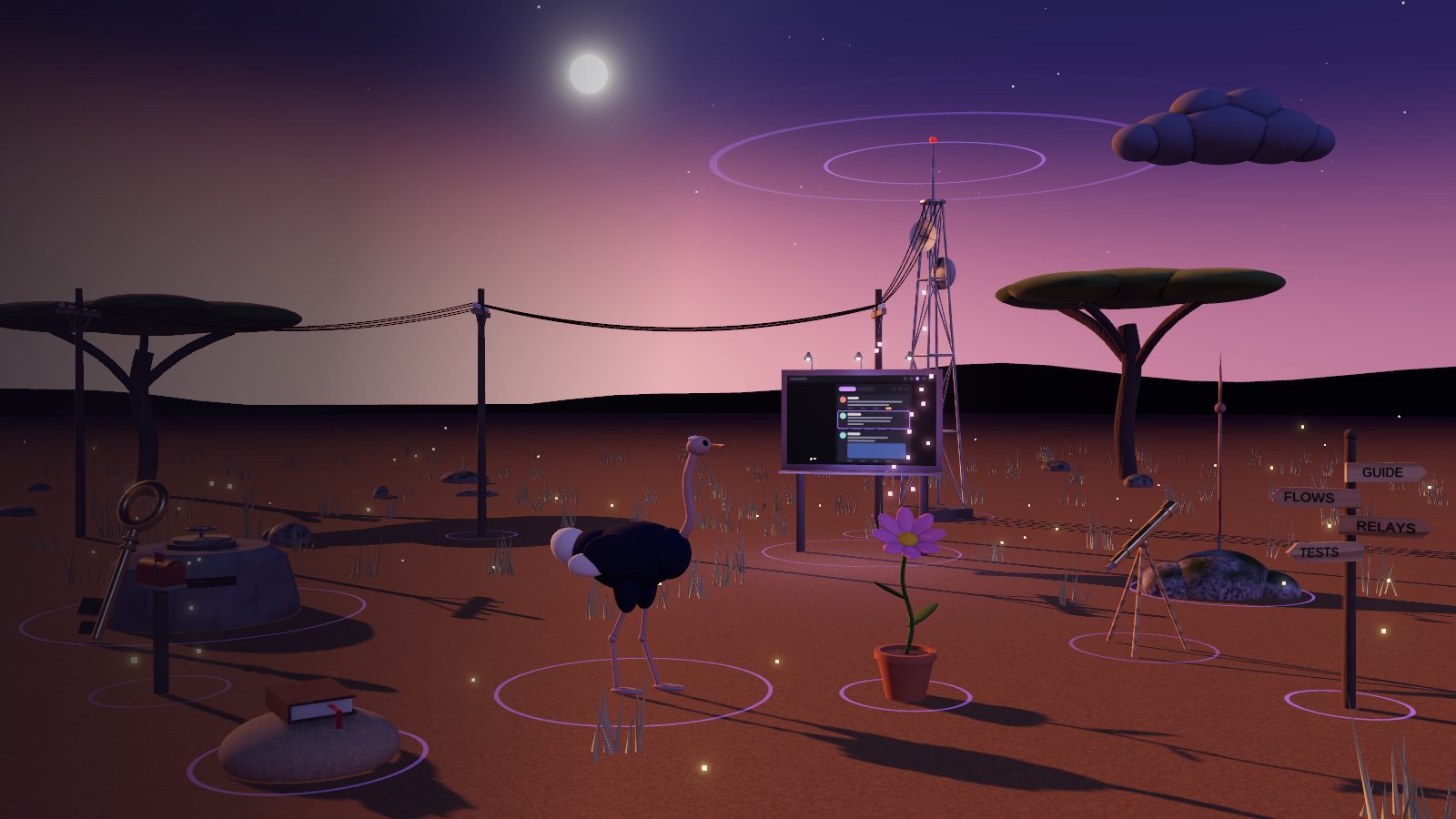
The ostrich
Notes and other stuff
Nostr is short for “Notes and Other Stuff Transmitted by Relays”. You are a key pair, what you say is a note you sign, and relays pass notes along. Any client reads the same notes, so nobody owns your account or your audience.
Its people call themselves ostriches. Avestruz is the Portuguese for one.
NIP-01
The mast
Relays
A relay is a plain server that keeps notes and hands them on. Nobody has to share one: each account says where it writes and where it reads, and a client looks for people there — the outbox model.
Avestruz reads everyone from the relays they write to, shows what each relay says of itself and warns about what it asks for, and lets you edit your own lists. No relay is built in for search or media: those are yours to choose.
NIP-65 NIP-11
The lines
Notes
Everything on Nostr is an event: a little signed message with a kind. A text note, a reply, a repost, a reaction, a comment — each travels from relay to relay, and anyone can check who signed it.
Avestruz shows the notes of the people you follow, with or without replies, opens any of them as its whole conversation, shows quoted notes in place, and keeps what it has seen so the feed is there at once the next time.
NIP-10 NIP-18 NIP-22 NIP-25
The bunker
Keys
Your identity is a key. The public half (npub) is your name; the secret half (nsec) signs what you say, and there is no “forgot my password”. A remote signer, a bunker, can hold the secret and sign on request, so a client never sees it.
Sign in to Avestruz with an nsec, an npub to only read, or a bunker:// address. Whatever is secret is kept in the system keyring and nowhere else.
NIP-19 NIP-46
The lightning rod
Zaps
A zap is a Lightning payment pinned to a note: a few sats sent straight to its author, with a receipt the relays carry so everyone can see it landed.
Avestruz counts the sats under every note and shows who sent them. To zap, it asks the author's Lightning address for an invoice and shows it as a QR code for your wallet; it holds no money itself, and says when the zap went through.
NIP-57
The flower
Pictures and videos
Notes are text. Pictures and videos live on media servers, filed under their own hash, and a note links to them — Blossom, as the scheme is called. Lose a server and the same file can be found on another.
Avestruz sends what you attach to your own servers and has the others fetch a copy. Before a picture leaves, everything in the file that is not the picture — where and when it was taken, with what — is left out. Videos play right in the feed, YouTube links too.
Blossom NIP-92
The mailbox
Writing
To publish is to sign a note and give it to relays: your own, and the ones the people you mention read. It counts once a relay has taken it.
Avestruz has a composer for notes, replies and quotes. What you wrote and did not send is never lost: it is encrypted to yourself and kept as a draft by a relay Avestruz runs inside itself, which listens on no port and serves nobody else.
NIP-37 NIP-44
The screen
In the panel
Avestruz is a button in the COSMIC panel and a popup that holds the whole client, as tall as your screen has room for. A key of your choosing opens it from anywhere.
Inside, the keyboard does everything: j and k walk the notes, l opens a thread, r replies, z zaps, b bookmarks, ? lists the rest. Close it mid-sentence and it is all still there when you come back.
The telescope
Search
No relay has everything, so search is something particular relays offer, and your account lists the ones you trust to do it.
Avestruz asks those and no others, for people and for notes at once, and puts the people you follow first. Nothing you search for is kept. Paste an npub, a note's address or a name at a domain and it opens straight away.
NIP-50 NIP-05
The book
Bookmarks
Lists are notes too: who you follow, what you keep, which relays you use. Part of a list can be encrypted, so that only you can read it, wherever you sign in.
Avestruz keeps bookmarks that way, private, and has a page to browse them. Bookmarked notes are also never dropped from its local store.
NIP-51
The signpost
Documentation
Avestruz says how it works. Its guide tells how the parts go together, what happens in which order, which relay is asked what, which NIPs are spoken, what was decided and why, and how it is tested — with diagrams, and every test by name.
It is written in the source, beside the code it is about, and published here from each change along with the documentation of every module.
The guide Architecture Flows Relays Protocol Decisions Testing Every module